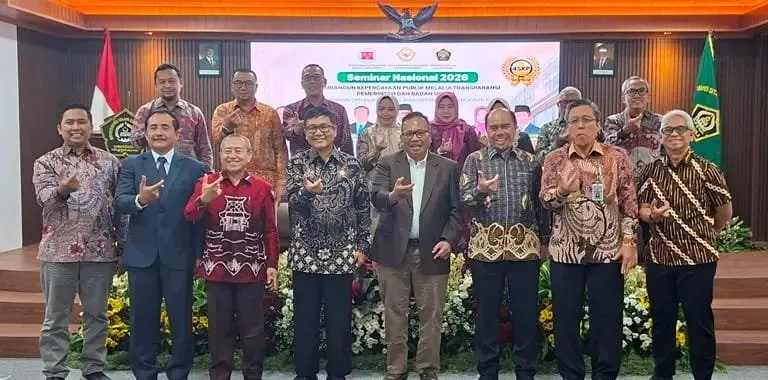

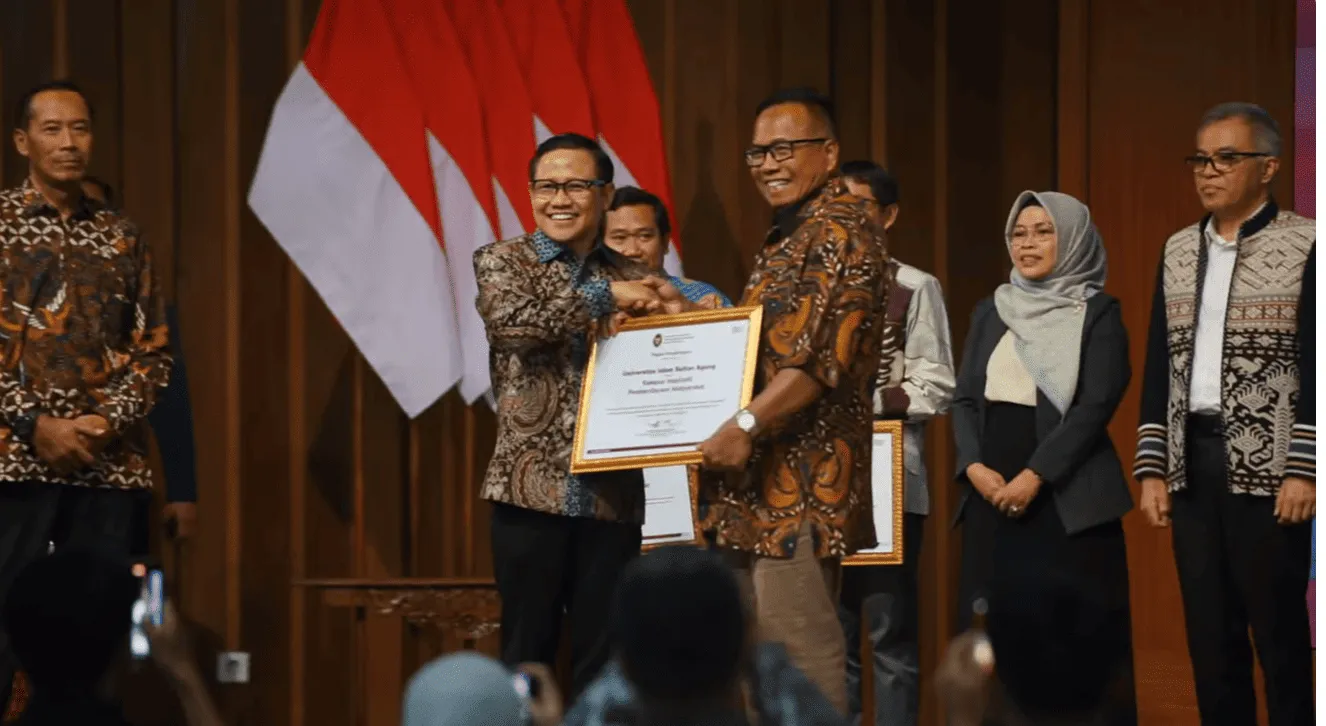
Sultan Agung Islamic University (Unissula) has received an award from the Coordinating Minister for Community Empowerment, Muhaimin Iskandar, in recognition of its commitment to supporting community empowerment. The award was accepted by the Rector of Unissula, Prof. Dr. Gunarto, S.H., M.H., on Thursday (October 15, 2026). The presentation took place during the National Coordination Meeting of the Higher Education Forum for Community Empowerment, held at Satya Wacana Christian University in Salatiga.
In addition to Unissula, the award was presented to 11 other higher education institutions: Satya Wacana Christian University, Cyber Asia University, Hasanuddin University, Atma Jaya University Yogyakarta, Nusa Cendana University, Dian Nuswantoro University, Soegijapranata Catholic University, the Indonesian University of Science, Technology, and Digital Economy, Sragen University, Duta Wacana Christian University, and the National Merchant Marine Polytechnic of Surakarta.
The leaders of these twelve institutions expressed a collective commitment—formalized through a declaration—to support the national agenda for poverty alleviation and the eradication of extreme poverty. As part of this commitment, scholarships will be provided to 2,792 village-level community empowerment cadres. This collaboration is expected to strengthen the role of higher education institutions in enhancing community capacity and expanding access to education.
This commitment also serves to support the accelerated implementation of the Presidential Instruction of the Republic of Indonesia Number 8 of 2025 concerning the Optimization of Poverty Alleviation and the Eradication of Extreme Poverty. Furthermore, the initiative aligns with the Decree of the Coordinating Minister for Community Empowerment Number 6 of 2026, which establishes priority locations for poverty alleviation and the eradication of extreme poverty for the year 2026.
The declaration underscores the moral and constitutional responsibility of higher education institutions to contribute to building a more just, prosperous, and thriving Indonesia. Higher education institutions are expected to serve not merely as educational bodies, but also as strategic partners to the government and the public in fostering empowerment and improving social welfare.
In his remarks, Minister Muhaimin Iskandar emphasized the importance of collaboration among all elements of the nation to achieve public welfare. He noted that the nation’s potential must be harnessed collectively through empowerment programs that involve the government, higher education institutions, and various segments of society.
"To realize a prosperous Indonesia, the nation must mobilize all its potential through collaborative efforts to empower the community. I am grateful to all rectors, leaders of rectors' forums, heads of higher education councils, and the entire academic community for remaining an integral part of development efforts through community empowerment," he stated.
Muhaimin affirmed the government’s commitment to alleviating poverty and enhancing public welfare. Such endeavors require a spirit of collaboration, integrated working models, and program management capable of accelerating the realization of prosperity. He stressed that community empowerment must be a core component of the nation’s development transformation.
He also underscored the importance of upholding the mandate of Article 34 of the 1945 Constitution, which outlines the state’s responsibility toward the impoverished and neglected children, as well as the development of a social security system and the empowerment of vulnerable and disadvantaged groups. This constitutional mandate, he argued, must be translated into policies and programs focused on the welfare of the people.
Meanwhile, the Governor of Central Java, Ahmad Luthfi, stated that the Central Java Provincial Government has established collaborations with various higher education institutions to improve public welfare. This includes, for instance, verifying data for the "Rehabilitation of Uninhabitable Housing" program, alongside various other community empowerment initiatives.
For Unissula, this recognition serves to reinforce the university’s commitment to fulfilling its roles in education, research, and community service. Through collaboration with the government and various stakeholders, higher education institutions are expected to expand access to education and enhance the capacity of communities, particularly in areas prioritized for poverty alleviation.
This shared commitment should not merely remain a declaration; rather, it must be translated into measurable and sustainable programs. With the involvement of higher education institutions, community empowerment efforts are expected to strengthen self-reliance, create broader opportunities, and foster improvements in the well-being of the Indonesian people.