
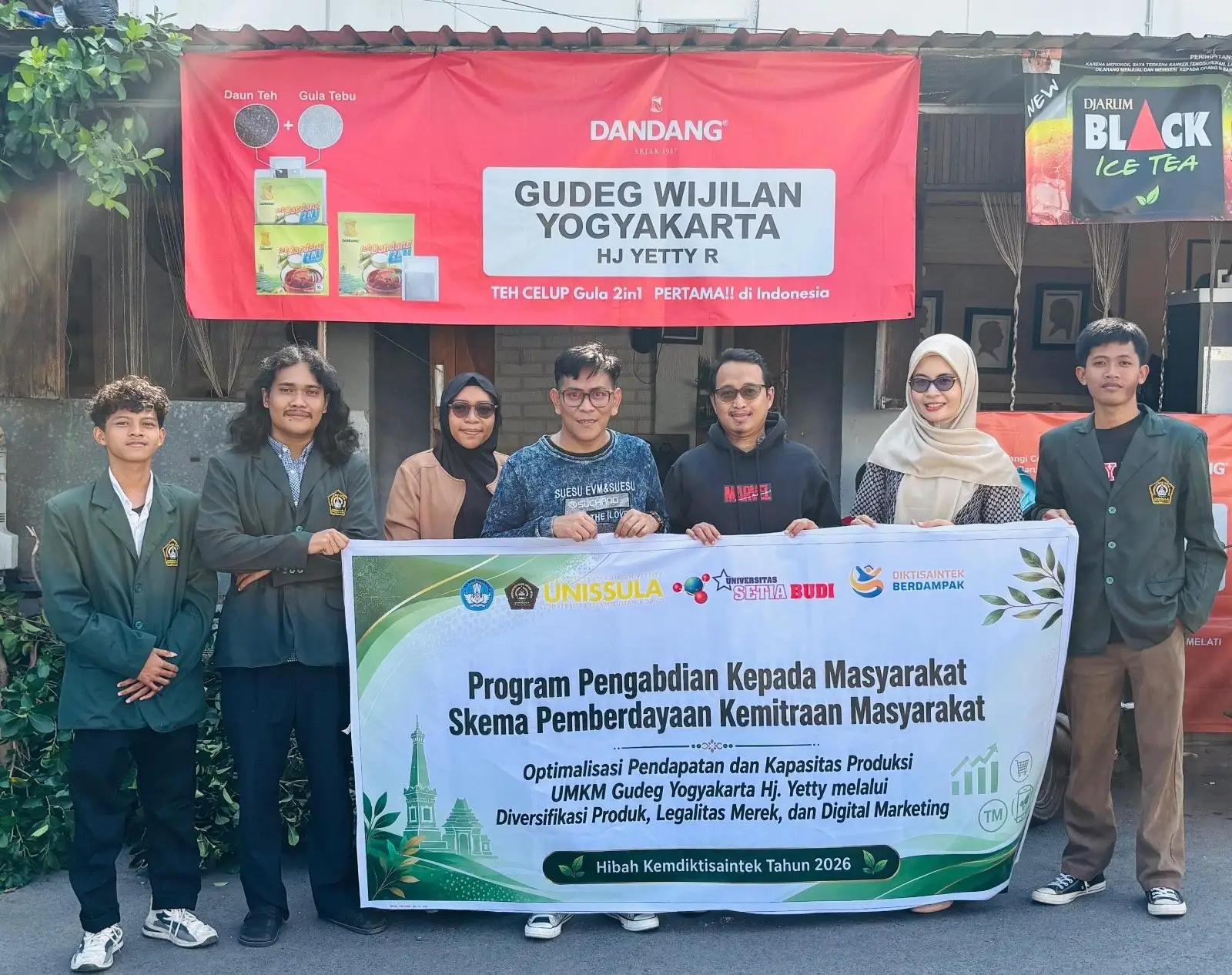
Semarang – Technological advancements and changing consumer patterns are encouraging traditional culinary businesses to not only maintain their flavors but also innovate in production, packaging, and marketing. Gudeg Yogyakarta Hj. Yetty, a Yogyakarta specialty culinary business in Semarang, has seized this opportunity through its Community Service (PkM) program, which focuses on increasing production capacity and expanding the market.
Gudeg Hj. Yetty has long been known as a Yogyakarta specialty culinary product that maintains authentic flavors through the use of select ingredients and recipes that have been passed down through generations. However, the business's development faces several challenges, including limited raw material storage, relatively short product shelf life, limited product packaging variety, brand protection, and suboptimal use of digital marketing.
This Community Service (PkM) program was funded through a grant from the Directorate of Research and Community Service (DPPM) of the Ministry of Education and Technology. This program is a collaboration between Sultan Agung Islamic University (UNISSULA) Semarang and Setia Budi University (USB) Surakarta, providing mentoring and implementing innovations for MSME partners. This cross-university collaboration combines competencies from various fields to support the comprehensive strengthening of partners' businesses.
Activities are implemented through mentoring, training, technology implementation, and evaluation approaches to help partners develop their businesses more sustainably. The Community Service Program (PKM) team involves lecturers and students with competencies in Industrial Engineering, law, and Information Technology, so that mentoring can cover aspects of production, business legality, and digital marketing.
One issue of concern is the storage capacity of raw materials and semi-finished products. The Gudeg Hj. Yetty production kitchen in the Tlogosari area of Semarang was previously affected by flooding, which damaged two freezer units. This situation also impacted raw material management and the smooth running of the production process.
Through the Community Service Program (PKM), partners received support with storage technology in the form of freezers, which are used to maintain the quality of raw materials and semi-finished products. The implementation of this equipment is expected to reduce the risk of material damage and help partners better manage the production process. Beyond production, this program also encourages product diversification so that Gudeg Hj. Yetty does not rely solely on ready-to-eat menu sales. The Community Service Team provided training and guidance on the use of vacuum chambers to produce vacuum-packaged products.
This diversification resulted in a number of products that could be developed into packaging, including gudeg (traditional Indonesian food), krecek (fried chicken), shredded chicken (chicken shredded), pindang eggs (spicy fish), and areh (sweet and sour sauce). Vacuum-packed products offer potential for marketing as souvenirs or delivery to consumers outside the city. Marketing transformation was also undertaken. The Community Service Team provided digital marketing assistance to enable partners to utilize digital technology to expand their consumer reach. One result of this activity was the launch of Gudeg Hj. Yetty on online food delivery platforms, allowing consumers to order more easily through delivery services.
In addition to expanding market access, strengthening business identity was a key part of this activity. Partners received assistance in the online trademark registration process through the Directorate General of Intellectual Property (DJKI). Brand protection is expected to strengthen their business identity and provide a better foundation for the long-term development of Gudeg Hj. Yetty.
This series of activities has begun to impact the development of partners' businesses. Increasing product variety, support for storage technology, and the use of digital platforms provide opportunities for Gudeg Hj. Yetty to reach a wider consumer base. For traditional culinary MSMEs, transformation does not necessarily mean abandoning inherited methods and values. Instead, technology can be utilized to strengthen business processes without losing the product's core character.
The experience of Gudeg Hj. Yetty demonstrates that traditional culinary preservation and innovation can go hand in hand. The distinctive flavor is maintained, while storage technology, product diversification, brand protection, and digital marketing are utilized to open up broader market opportunities.
With the collaborative support of UNISSULA Semarang and USB Surakarta, this Community Service Program (PKM) is expected to not only provide short-term benefits for partners but also become part of the university's efforts to encourage the strengthening of MSMEs, the application of scientific findings, and the development of local economic potential based on