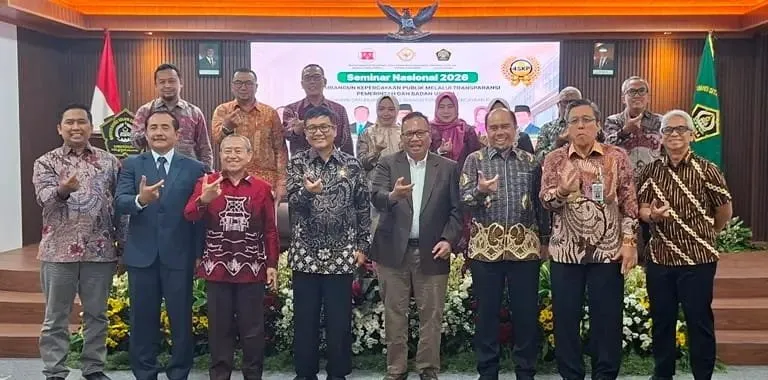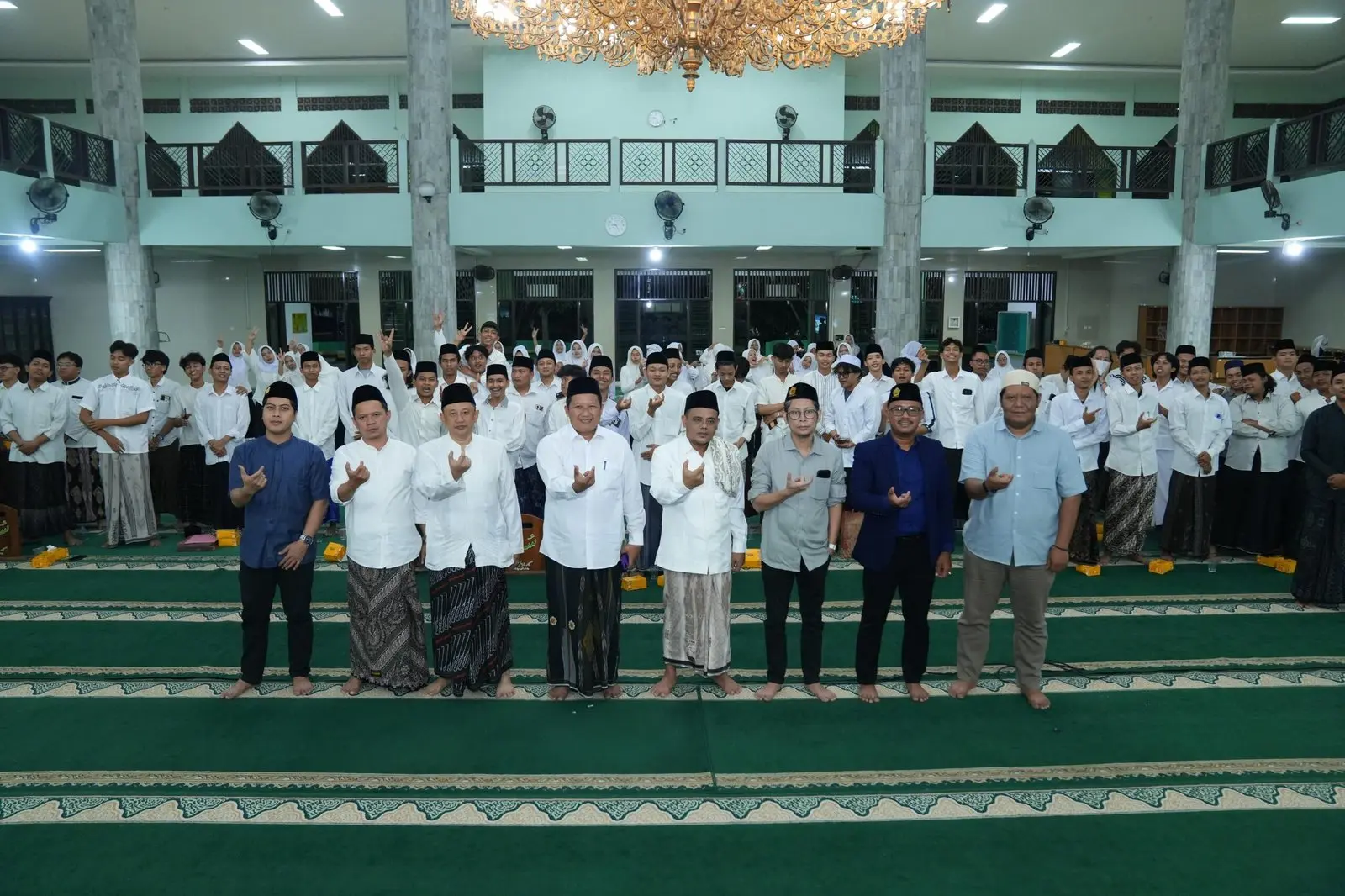
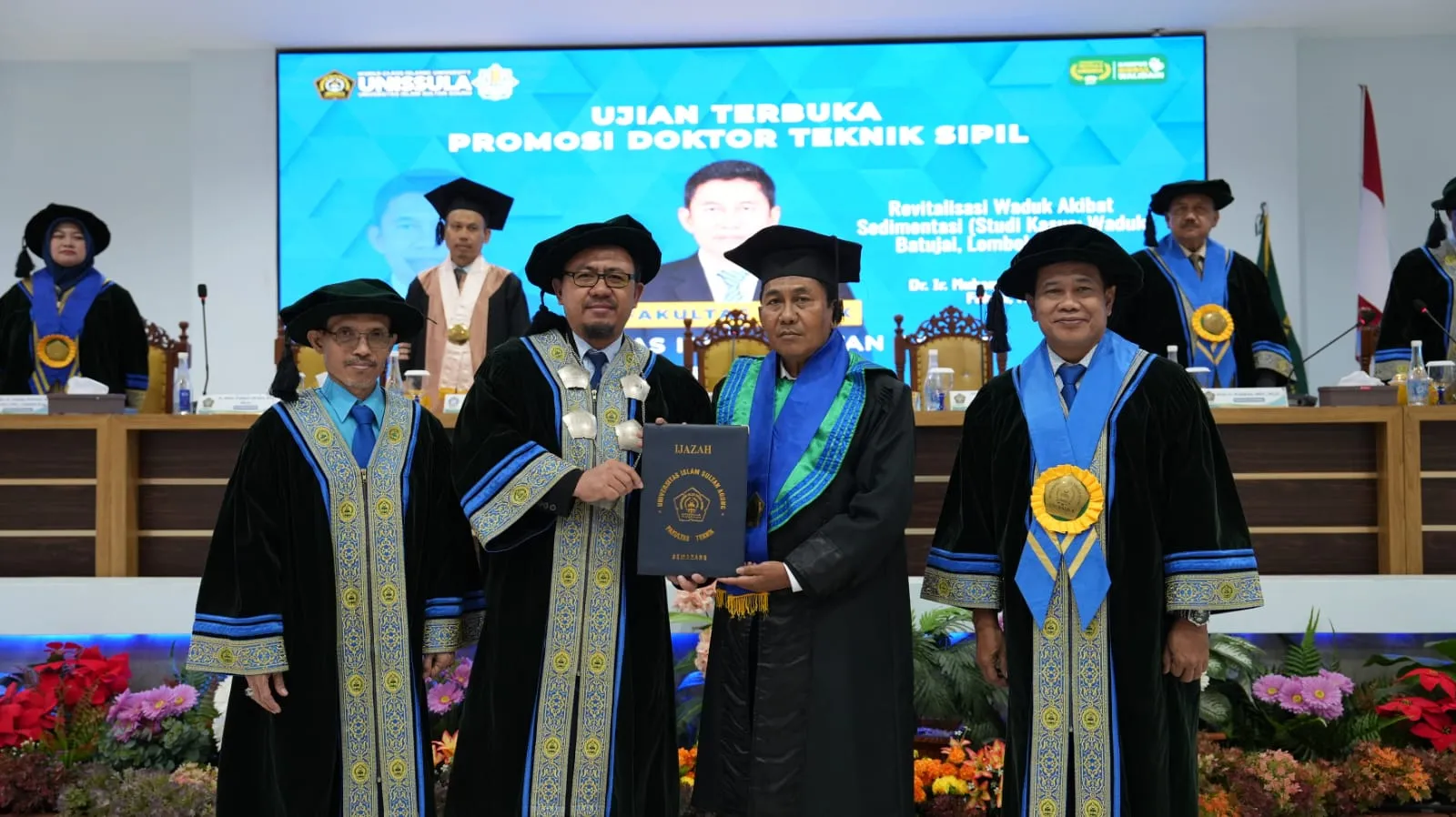
The Doctoral Program in Civil Engineering (PDTS) at the Faculty of Engineering, Sultan Agung Islamic University (Unissula) Semarang, graduated a new doctor on Thursday (November 19, 2026). During an open doctoral defense, Ir. Muhammad Arifuddin Fahmi, M.T., successfully defended his dissertation titled "Revitalization of a Reservoir Affected by Sedimentation (Case Study: Batujai Reservoir, Central Lombok)."
He is officially the 72nd doctoral graduate from the Civil Engineering Doctoral Program at Unissula’s Faculty of Engineering, achieving a Cumulative Grade Point Average (GPA) of 3.67.
The doctoral defense was supervised by Prof. Dr. Ir. S. Imam Wahyudi, D.E.A., serving as the promoter, and Ir. Moh. Faiqun Ni’am, M.T., Ph.D., as the co-promoter.
In his presentation before the board of examiners, Dr. Ir. Muhammad Arifuddin Fahmi, M.T., highlighted the critical condition of the Batujai Reservoir, located in the Southwest Praya District, Central Lombok Regency, West Nusa Tenggara Province. In operation since 1982, the reservoir—situated within the Dodokan watershed—plays a vital role for the people of Lombok Island, supporting irrigation, flood control, raw water supply, and hydroelectric power generation. However, a high rate of sedimentation now threatens the reservoir's continued operation.
"Based on bathymetric data and modeling, sedimentation has filled 93.8 percent of the reservoir's planned 'dead storage' capacity of 1.4 million cubic meters. Consequently, the remaining effective lifespan of the Batujai Reservoir is in a critical state—estimated at only 4 to 6 years—which is significantly shorter than its original planned lifespan of 50 years," Arifuddin explained during his presentation. This sedimentation issue has led to a 27.58 percent decline in irrigation services, resulting in potential losses in the agricultural sector estimated at IDR 49.9 billion annually.
Employing a quantitative approach and 1D/2D hydrodynamic modeling—using MIKE 11/21 software—alongside an analysis based on the Universal Soil Loss Equation (USLE) across five sub-catchment areas covering 130.43 km², this study identifies the Sade River and the Dodokan/Surabaya sub-catchment as the primary sources of sediment and erosion flowing into the reservoir. Furthermore, sediment production is heavily influenced by seasonal factors, with 78.17 percent of sediment transport occurring during the rainy season (November–March).
As a strategic solution for the revitalization and extension of the reservoir’s operational lifespan, this dissertation recommends technical conservation interventions in the upstream areas: the construction of five check dams (sediment-retention barriers), each with an effective crest height of 2 meters—three located on the Sade River and two on the Dodokan/Surabaya River.
Simulation results indicate that the construction of these five check dams could reduce the rate of sedimentation entering the Batujai Reservoir by 56.56 percent (from 25,090 m³/year to 10,899 m³/year). This intervention is shown to significantly extend the reservoir’s effective service life from the current 4–6 years to 12.8 years.
In addition to physical construction, the study emphasizes the importance of seasonal maintenance management. It is recommended that sediment trapped by the check dams be cleared or dredged at least once a year during the dry season to ensure optimal storage capacity before the peak of the rainy season; this should be complemented by reforestation efforts within the upstream catchment areas. His success in earning a doctoral degree is expected not only to add to the ranks of civil engineering experts from Unissula but also to provide a tangible contribution to stakeholders in the water resources sector, helping to safeguard nationally strategic dam infrastructure from the threat of sedimentation.