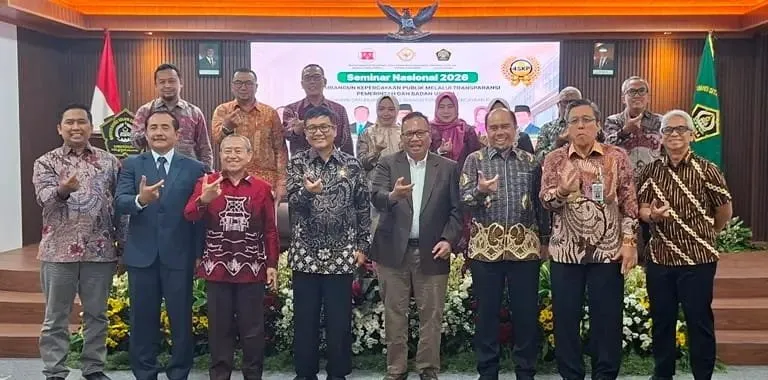


Rizki Adi Pinandito, a lecturer at the Faculty of Law, Sultan Agung Islamic University (Unissula), underwent his doctoral open examination at the Doctoral Program in Law, Faculty of Law, Universitas Sebelas Maret (UNS) Surakarta. The open examination took place on Thursday (October 1, 2026). During the exam, Rizki presented a dissertation titled "A Model of Legal Protection for Children's Rights to be Free from Violence in Cyberspace Based on the Convention on the Rights of the Child."
The dissertation addresses the issue of child protection in cyberspace. Rizki examined legal protections against violence targeting children in the digital realm. The research utilized the principles of the Convention on the Rights of the Child (CRC) as a primary foundation.
According to Rizki, the research had two main objectives. First, to evaluate the existing model of legal protection regarding children's rights to be free from violence in cyberspace in Indonesia. Second, to formulate an ideal legal protection model through a comparative study between Indonesia and Malaysia.
The research employed a normative-doctrinal legal method. The approaches used included statutory, conceptual, and comparative approaches. Primary, secondary, and tertiary legal materials were gathered through literature reviews and online legal databases, then analyzed using a normative-qualitative approach.
The research findings indicate that Indonesia has made progress in protecting children from violence in cyberspace. This development is evident in regulations and policy directions that increasingly align with the principles of the Convention on the Rights of the Child. However, challenges remain because regulations concerning children and cyberspace are still partial, fragmented, and lack comprehensive operational implementation.
Rizki also found that cyberspace has not yet been established as a distinct legal domain within the child protection system. This situation poses a challenge to providing more effective protection. Technological advancements mean that forms of violence against children in cyberspace increasingly require a rapid and integrated legal response.
Formulating an Integrated Protection Model
Based on research findings and a comparative study with Malaysia, Rizki proposes a Risk-Based Integrated Legal Protection Model for Children in Cyberspace. This model represents a *ius constituendum* (proposed law) framework that integrates state obligations with the responsibilities of technology corporations. It is designed to provide protection spanning from prevention to recovery for child victims.
The model encompasses several stages of protection, including prevention, child-friendly reporting, rapid response, and the securing of digital evidence. Additionally, it addresses content mitigation and the remediation of the victim's digital footprint.
According to Rizki, cyberspace differs fundamentally from physical space; violence in cyberspace can spread rapidly and leave long-lasting digital traces. Consequently, the legal system requires mechanisms capable of delivering a swift response while simultaneously guaranteeing the restoration of children's rights.
Contribution to Legal Development
This research is expected to contribute to the development of child protection laws in Indonesia. The study offers insights into the importance of integrating the roles of the state and technology corporations, both of which play a crucial part in creating a safer online environment for children.
Rizki recommends further research to test the implementability of the proposed model. Such testing could assess institutional readiness, funding, and the effectiveness of cross-sectoral mechanisms. Strengthening performance indicators is also essential to ensure that the implementation of protection measures can be evaluated in a measurable way.
Further research could also involve comparative studies with other jurisdictions. Socio-legal analysis is needed to examine the actual state of child protection within communities, with particular attention paid to underdeveloped, frontier, and outermost (3T) regions. The dissertation was supervised and examined by Promoter Prof. Dr. Hartiwiningsih, S.H., M.Hum., and Co-Promoter Dr. Muhammad Rustam Aji, S.H., M.H. The other examiners were Dr. Sasmini, S.H., LL.M.; Dr. Erna Dyah Kusumawati, S.H., M.Hum., LL.M.; Prof. Dr. Jamal Wiwoho, S.H., M.Hum.; Dr. Subekti, S.H., M.H.; Dr. Andriana Grahani Firdausy, S.H., M.H.; Dr. Diana Tantri Cahyaningsih, S.H., M.Hum., M.Kn.; and Prof. Dr. Sri Endah Wahyuningsih, S.H., M.Hum.
Rizki’s study represents an academic contribution by a lecturer from the Unissula Faculty of Law in responding to legal developments in the digital era. The research also highlights the importance of strengthening legal protection systems for children amidst the expanding use of cyberspace. The findings are expected to serve as a reference for developing more integrated policies and legal systems to protect children's rights in the digital space.