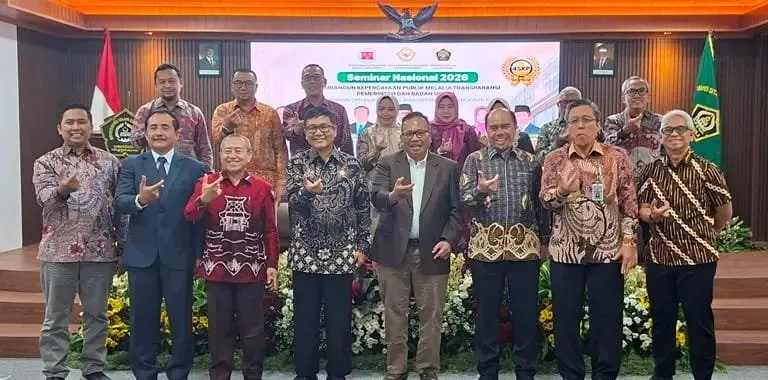
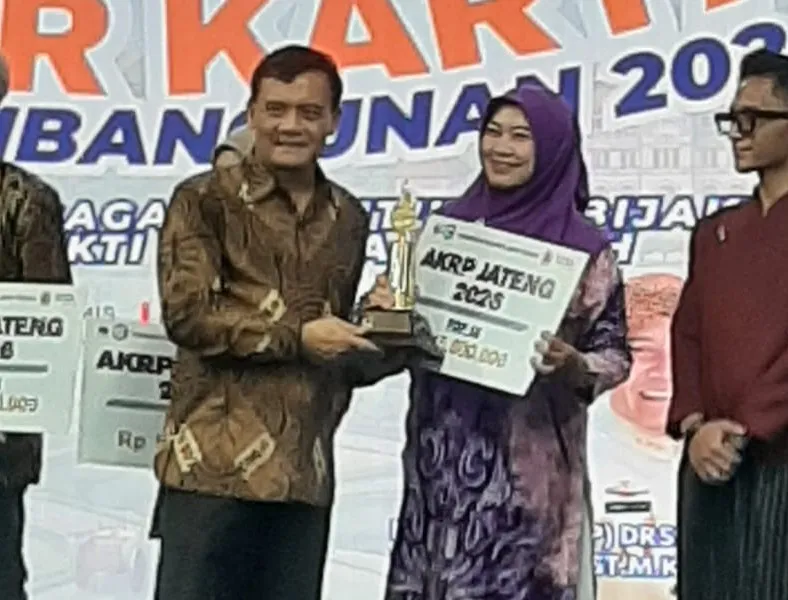
The Head of the Institute for Research and Community Service (LPPM) at Unissula, Prof. Dr. Ir. Henny Pratiwi Adi, ST, MT, IPU, ASEAN Eng., has received the 2026 Central Java Development Research Achievement Award (Anugerah Karya Riset Pembangunan/AKRP). The award was presented personally by the Governor of Central Java, Commissioner General of Police (Ret.) Drs. Ahmad Luthfi, SH, SSt, MK, on Thursday (October 15, 2026). The presentation took place during the 2026 Development Research Exhibition—themed "Connecting Ideas for Evidence-Based Policy in Central Java"—held at the Gradhika Bhakti Praja Building.
The event served as the culmination of the 2026 Central Java AKRP series, organized by the Central Java Regional Research and Innovation Agency (BRIDA). The competition honors researchers whose work contributes to regional development, with the expectation that their findings will serve as a foundation for formulating more targeted, evidence-based public policies.
For the competition, Prof. Henny submitted research titled "Styrofoam-Based Floating Platforms for Habitable Floating Houses: An Adaptive Solution for Areas Affected by Tidal Flooding." This research offers an alternative technological approach to support the provision of decent housing for coastal communities frequently impacted by tidal floods. The concept aligns with the need to develop adaptive solutions for coastal regions in Central Java, including Demak and Pekalongan.
Tidal flooding poses a significant challenge for coastal communities, as seawater inundation disrupts daily activities and compromises the habitability of homes. One approach being developed is the "floating house"—a structure designed to adjust its position in response to changes in water levels. In this system, a floating platform acts as both a support structure for the building and a replacement for a conventional foundation.
Floating houses already constructed by the Central Java Provincial Government in the Demak Regency utilize platforms made from plastic drums. However, the use of such materials presents several limitations, particularly regarding durability, stability, and comfort. This situation highlights the need for alternative materials capable of delivering better performance.
Through her research, Prof. Henny proposes the use of styrofoam panels coated with lightweight concrete—a mixture incorporating styrofoam beads. This design was evaluated through a series of calculations and analyses to assess its potential for buoyancy and structural stability. The findings indicate that a platform constructed from styrofoam panels coated with lightweight concrete could serve as a viable alternative to the use of plastic drums.
According to the research, the proposed material offers superior buoyancy and stability, while also enhancing the durability and comfort of floating homes. These findings pave the way for the development of floating home prototypes using materials better suited to the conditions of coastal areas. Nevertheless, broader implementation would still require technical testing, structural safety assessments, long-term durability evaluations, and an analysis of site-specific suitability.
Prof. Henny’s research is expected to serve as a reference for developing adaptive housing in regions prone to tidal flooding (rob). The floating platform model—utilizing styrofoam panels coated with lightweight concrete—warrants further study for potential application in various coastal areas across Central Java. Regions such as Semarang, Pekalongan, Brebes, and Demak face coastal challenges that make them well-suited for the development of such solutions.
Beyond offering a technological alternative, this research underscores the importance of connecting academic research with the tangible needs of the community. Innovations developed through scientific inquiry should not merely remain as academic publications; rather, they should serve as input for the government in formulating development policies. In this way, research can contribute to improving housing quality and community resilience in areas affected by tidal flooding.
The 2026 Central Java AKRP (Applied Research and Innovation Competition) features 609 research projects submitted by various researchers. Following a selection process, the competition identified the 10 best publications from researchers at universities and the National Research and Innovation Agency (BRIN), as well as two research professionals from Central Java who were recognized for their productivity and impact in the fields of science and technology, as well as the social sciences and humanities.
The selected works were further developed into policy briefs—concise summaries of policy recommendations based on research findings. These documents are designed to provide the local government with focused analysis and actionable recommendations. This approach is intended to strengthen the integration of research outcomes into the formulation of development policies.
Strengthening research and innovation is a key component of the Central Java Provincial Government’s efforts to realize its vision of becoming an advanced and sustainable province, in line with the "Golden Indonesia 2045" (Indonesia Emas 2045) vision. Through this recognition, it is hoped that researchers' work will gain greater scope to contribute to addressing various challenges.