
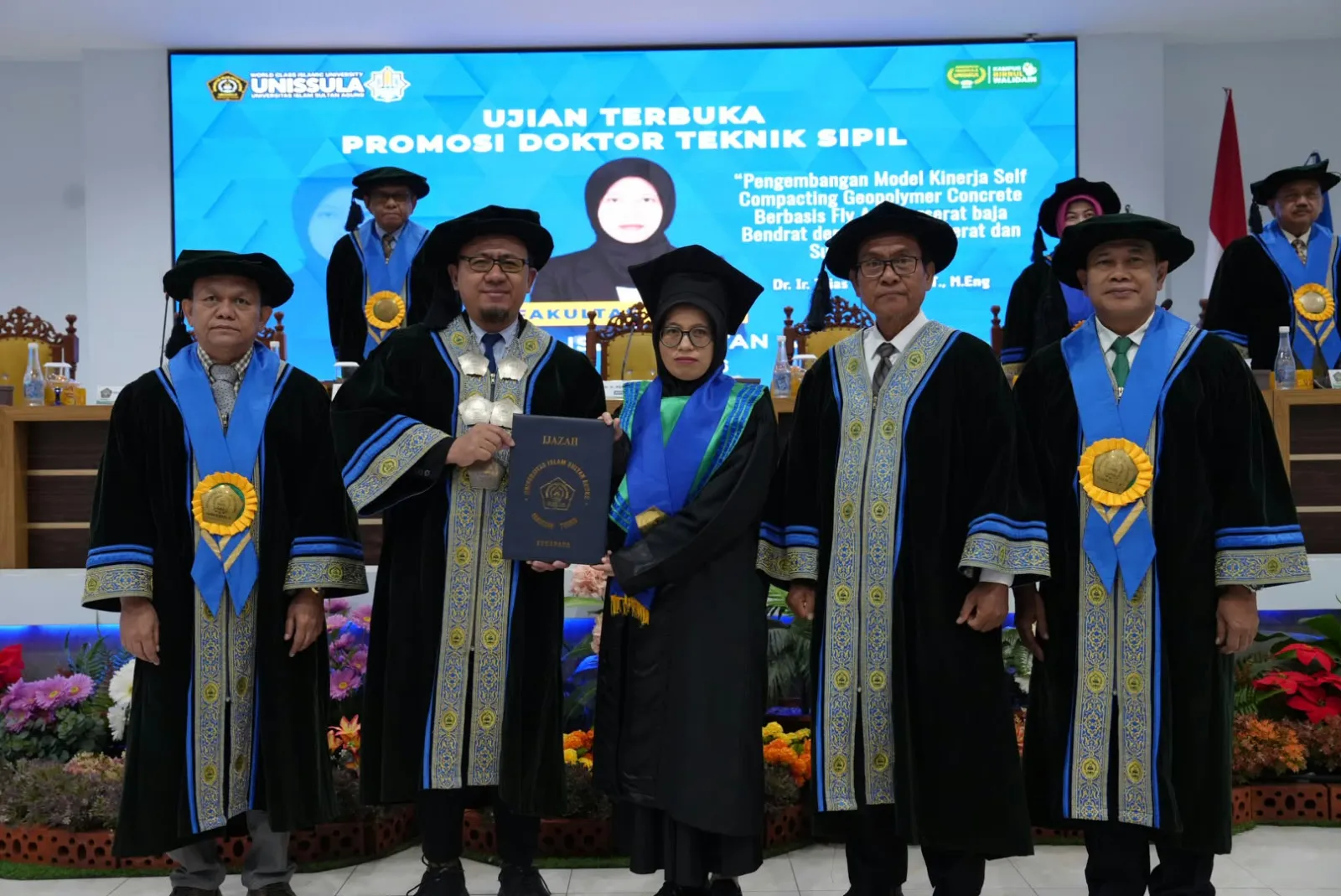
Ir. Trias Widorini, S.T., M.Eng., has officially become the 70th doctoral graduate from the Civil Engineering Doctoral Program at Sultan Agung Islamic University (Unissula). She completed her doctoral studies in 3 years and 1 month, achieving a cumulative grade point average (GPA) of 3.90. The open defense was presided over by the Dean of the Faculty of Engineering at Unissula, Dr. Abdul Rochim, S.T., M.T.
During her dissertation defense on Friday (November 6, 2026), Trias presented research titled "Development of a Performance Model for Fly Ash-Based Self-Compacting Geopolymer Concrete Reinforced with Steel Fibers, Incorporating Variations in Fiber Content and Superplasticizer Dosage."
The research focuses on developing a more environmentally friendly geopolymer concrete by utilizing fly ash—a waste byproduct from steam power plants (PLTU)—combined with steel fibers and a superplasticizer to enhance the concrete's performance.
The study was motivated by the need to mitigate the environmental impact of the cement industry, which is responsible for approximately 7–8 percent of global carbon dioxide (CO₂) emissions. Using fly ash as an alternative binder serves as a strategy to create more sustainable construction materials.
However, incorporating steel fibers into concrete mixtures presents specific challenges. While fibers can improve strength and crack resistance, they can simultaneously reduce the flowability of the mixture. Consequently, this research combines steel fibers with a superplasticizer to achieve an optimal balance between the concrete's flowability and its mechanical performance.
In her study, Trias utilized Class F fly ash from the Tanjung Jati Steam Power Plant in Jepara as a binder, along with steel fibers at volume fractions of 0%, 0.5%, and 1%, and a polycarboxylate ether (PCE)-based superplasticizer at dosages of 0.5%, 2.5%, and 4.5%. The research was conducted using nine mixture combinations, with 243 test specimens evaluated in the laboratory.
The results indicate that all nine mixture variations meet the criteria for self-compacting concrete as defined by EFNARC (2005). Superplasticizers play a dominant role in controlling the flowability of the concrete, while the addition of steel wire fibers increases the viscosity of the mixture.
In terms of strength, the developed concrete achieved a compressive strength of 32.46–48.31 MPa at 56 days. These results demonstrate that all mixture variations qualify as structural-grade concrete, even when cured at room temperature without the use of heat curing.
The study also found that the splitting tensile strength of the concrete reached 3.18–5.10 MPa, while the flexural strength reached 4.44–7.24 MPa. Steel wire fibers serve as a critical factor in enhancing tensile and flexural capacity through a "crack-bridging" mechanism, where the fibers span across cracks, thereby controlling their propagation.
Shear strength testing yielded values ranging from 4.55 to 14.85 MPa, with an average of 7.95 MPa. The addition of fibers increased the shear strength by approximately 79 percent. Meanwhile, the average maximum bond strength reached 31.10 MPa for D10 reinforcement bars and 29.50 MPa for D13 bars.
Another aspect examined was the concrete's microstructure, analyzed using Scanning Electron Microscopy-Energy Dispersive X-Ray (SEM-EDX) testing. The results reveal a relatively dense and continuous geopolymer matrix, with a tight interface between the fibers and the matrix. This condition facilitates stress transfer and contributes to the improved mechanical performance of the concrete.
A significant contribution of this research is the development of 12 multi-parameter empirical regression models, with coefficients of determination (R²) ranging from 0.889 to 0.9997. The model is used to predict various characteristics of concrete while simultaneously determining the optimal mix composition.
Through a Pareto–Desirability optimization approach, the study yielded 74 non-dominated solutions that represent a balance between flowability and mechanical performance. The recommended optimal composition consists of a 4% superplasticizer dosage and 1% hooked-end steel fibers.
For this composition, the model predicts a compressive strength of 38.62 MPa, a splitting tensile strength of 4.74 MPa, a flexural strength of 6.94 MPa, a shear strength of 7.40 MPa, and bond strengths of 30.73 MPa and 30.70 MPa for D10 and D13 reinforcement bars, respectively. All characteristics of the fresh concrete at this composition are predicted to meet EFNARC criteria.
The results of this research are expected to contribute to the development of geopolymer concrete technology based on industrial waste, specifically by producing more environmentally friendly construction materials with quantifiable mechanical performance. The developed prediction model can also serve as a tool for the preliminary design of concrete compositions, allowing for a more focused mix design process and reducing the reliance on trial-and-error methods.
In the preparation of this dissertation, Trias Widorini was supervised by ...by Promoter Prof. Dr. Ir. Antonius, M.T., I.P.U., and Co-Promoter Dr. Ir. Sumirin, M.S.