
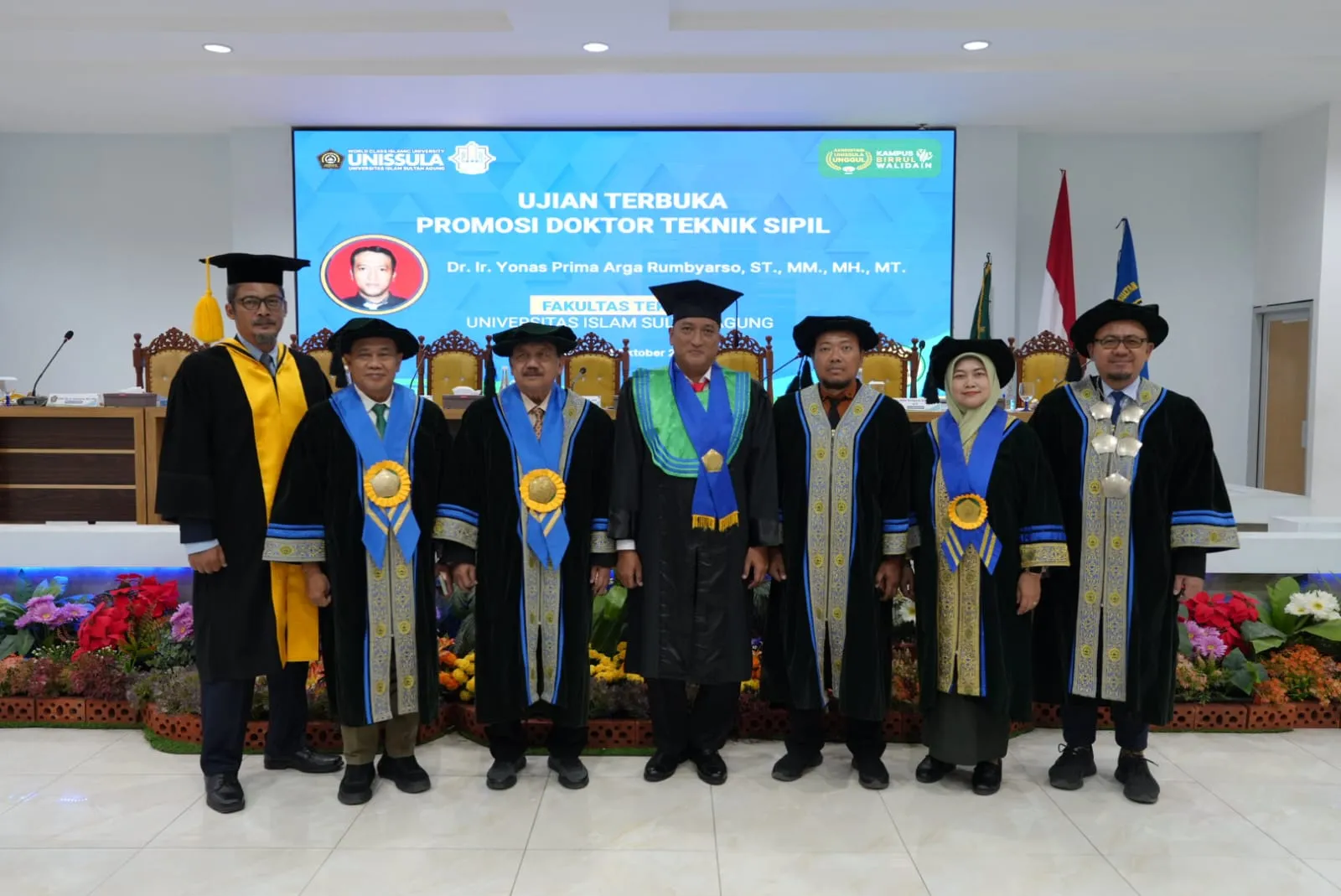
Sultan Agung Islamic University (Unissula) has produced another doctoral graduate through the Open Doctoral Promotion Examination of its Civil Engineering Doctoral Program (PDTS). Ir. Yonas Prima Arga Rumbyarso, ST, MM, MH, MT, became the 68th graduate of the program, achieving a cumulative grade point average (GPA) of 3.81. The open examination took place on Friday, October 16, 2026.
During the examination, Yonas presented his dissertation titled "Modeling the Mechanical Response of Soft Soil in Flexible Pavement Systems Subjected to Variations in Moisture Content." The research examines how changes in moisture content affect the mechanical response of soft soil and road pavement structures, specifically regarding stress, strain, deflection, and deformation.
The study was motivated by the challenges posed by soft soil, which is characterized by low bearing capacity, high compressibility, and low permeability. These conditions present significant hurdles for road construction and maintenance, particularly on sections subjected to heavy vehicle traffic. An increase in moisture content can compromise soil strength and heighten the risk of deformation within pavement structures.
In his research, Yonas analyzed the physical, mechanical, and mineralogical characteristics of soft soil from the Telukjambe Barat and Tempuran areas in Karawang Regency. The study further involved testing a 1:20 scale physical model of a flexible pavement at moisture content levels of 19%, 36%, and 53%. The laboratory test results were then compared with numerical simulations conducted using PLAXIS 2D software.
The findings indicate that an increase in moisture content significantly influences the mechanical response of the pavement. At a moisture content of 53% and following 150 load repetitions, the deformation of the asphalt surface reached 0.4063 mm. Furthermore, deflection increased from 0.0749 mm at a moisture content of 19% to 0.3721 mm at a moisture content of 53%. Meanwhile, the measured stress decreases as the number of load repetitions and the moisture content increase.
A comparison between the experimental results and the PLAXIS 2D simulations indicates that the numerical model is capable of capturing the general patterns of mechanical response, although some values remain lower than those obtained from laboratory testing. The most significant discrepancy is observed in the deflection parameters. Consequently, further calibration of material parameters is required to ensure that the modeling results more closely align with the experimental conditions.
This research integrates the mineralogical and mechanical characteristics of the soil, testing of layered pavement systems, and numerical simulations. The findings underscore the importance of accounting for moisture content when evaluating and designing road pavements constructed on soft soil. Controlling water infiltration and implementing effective drainage systems are also critical aspects for supporting the performance of road structures.
In the preparation of this dissertation, Yonas was supervised by Prof. Ir. H. Pratikso, M.St., Ph.D., serving as the primary supervisor, and Dr. Rifqi Brilyant Arief, S.T., M.T., as the co-supervisor. This research is expected to contribute to the advancement of civil engineering, particularly in the design and evaluation of road pavements on soft soil.