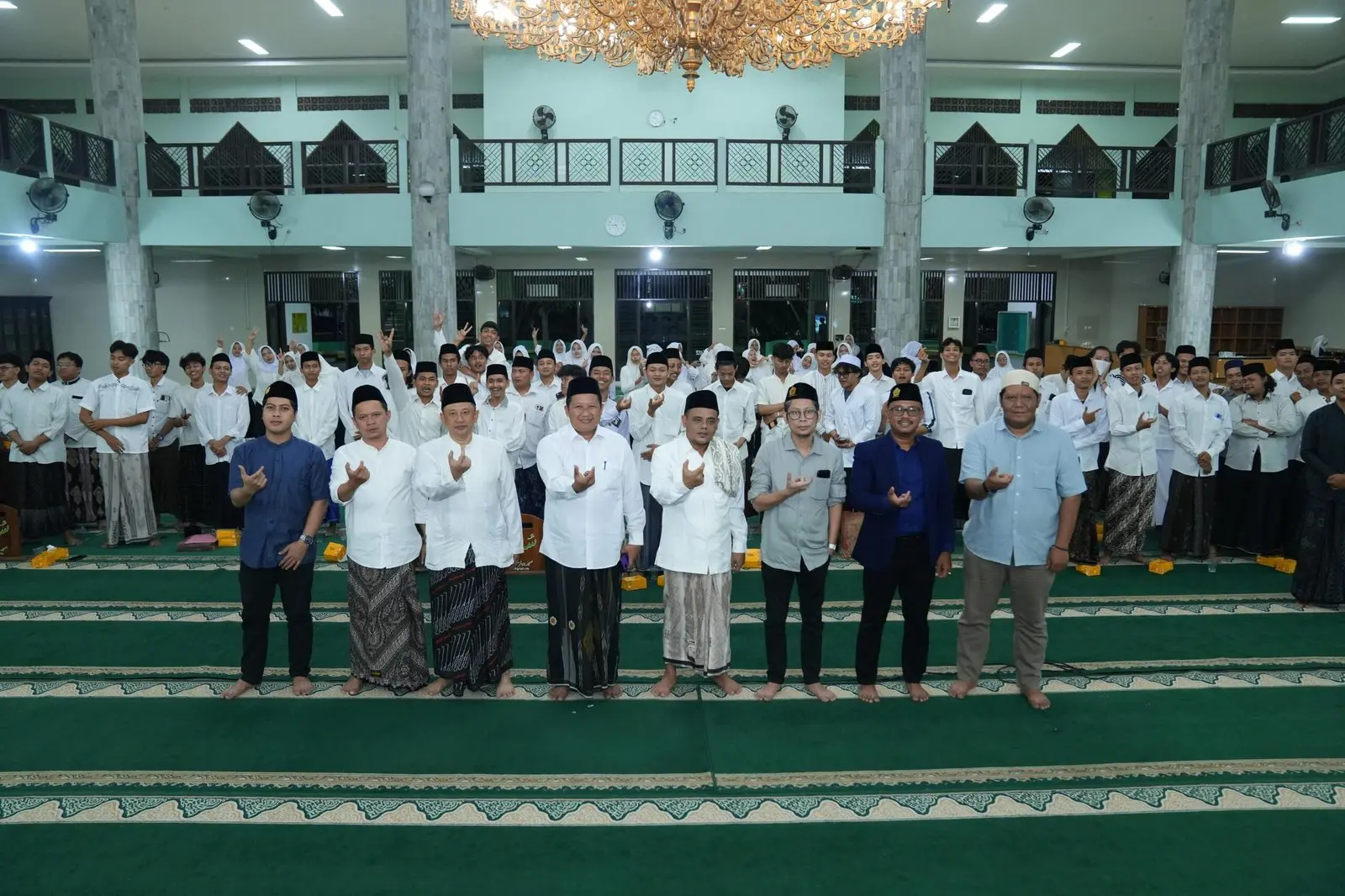
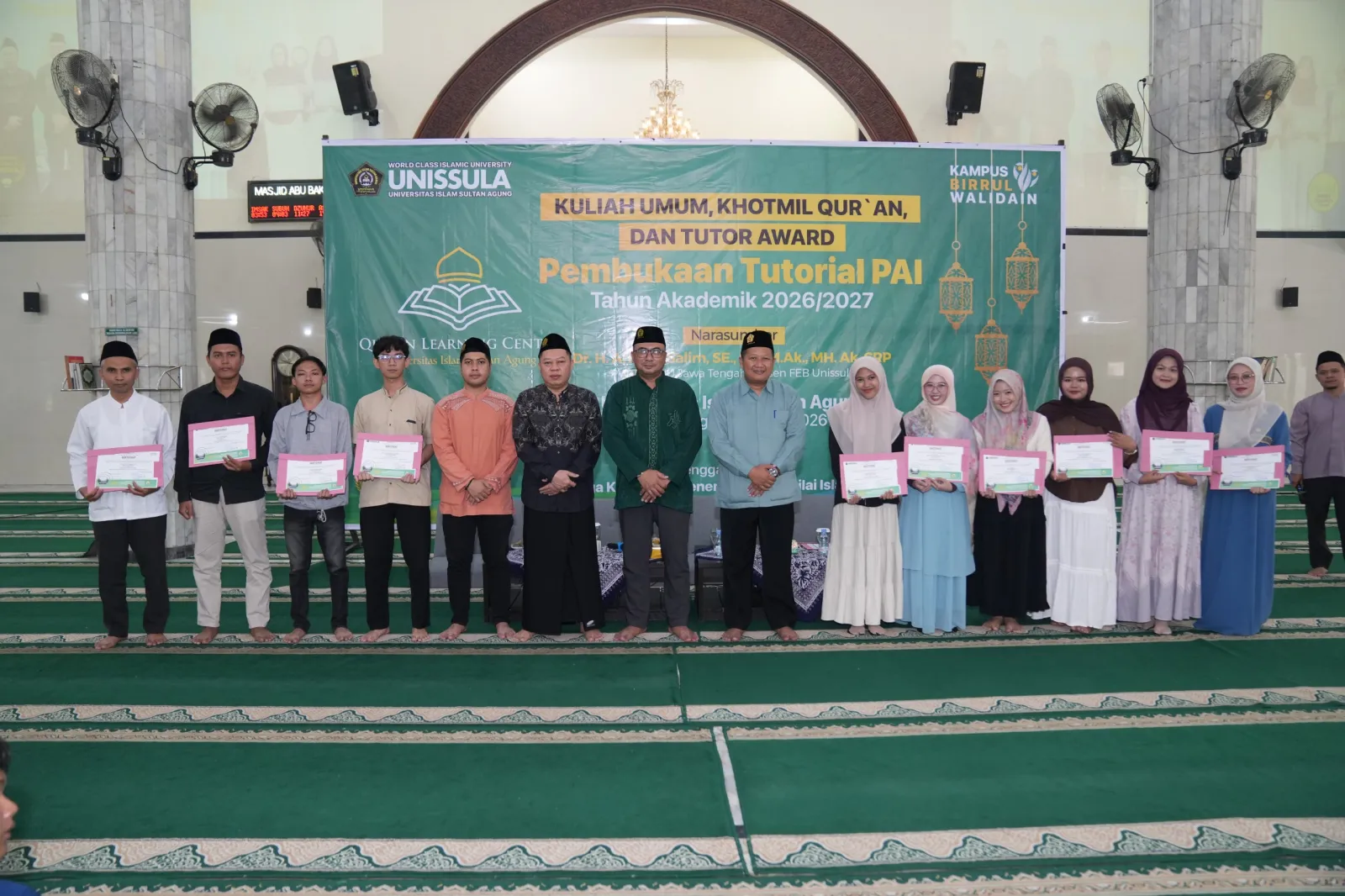
Unissula’s Institute for Islamic Studies and Implementation (LKPI) held the opening ceremony for the Islamic Religious Education (PAI) tutorial program for the 2026/2027 academic year on Saturday (October 10, 2026). The event featured a *Khotmil Qur’an* (Quran completion ceremony), a public lecture, and the presentation of Tutor Awards.
The event served as an opportunity to reinforce the commitment of both tutors and participants to Islamic religious learning. It also supported the cultivation of an Islamic character within the campus environment.
The proceedings began with a *Khotmil Qur’an* session led by the dedicated *Khotmil Qur’an* team, an activity aimed at maintaining a close connection with the Quran. This was followed by an introduction to the PAI tutors, encompassing both returning and new tutors.
The event was attended by Unissula’s Vice Rector III, Dr. Achmad Arifulloh, S.H., M.H. Also present were the Head of LKPI Unissula, Moh. Farhan, S.Pd.I., S.Hum., M.Pd.I., CWC, and the Head of the Quran Learning Center (QLC) Unissula, Dr. Sugeng Hariyadi, Lc., M.A. Additionally, Dr. Lela Zumala Rofiqoh, S.Ak., M.M., and Ustadz Mustain, S.Pd.I., M.Pd.I., were in attendance.
In his remarks, Vice Rector III Dr. Achmad Arifulloh encouraged all participants to spread messages of goodness and to strengthen one another. He emphasized the importance of maintaining a close bond with the Quran through activities such as the *Khotmil Qur’an*.
He also noted that the Tutor Award serves as a token of appreciation for the tutors' dedication and exemplary conduct. He stated that Unissula bears the mandate of building a *khaira ummah* (an exemplary community). Consequently, PAI tutors play a crucial role in shaping the Islamic Academic Culture (BUDAI).
Tutors are expected to do more than simply convey religious material; they must also serve as role models through their daily attitudes and behavior. The educational mandate entrusted to them must be carried out with a deep sense of responsibility. He extended his congratulations to the Tutor Award recipients, expressing hope that the award would serve as encouragement for them to further enhance their service. Meanwhile, tutorial participants were encouraged to utilize this program to deepen their religious knowledge and improve their practice of worship. The tutorial sessions also serve as a means to build friendships and mutually encourage one another in doing good.
The event proceeded with the announcement of the Tutor Award recipients, read by the Head of the Unissula QLC Division, Dr. Sugeng Hariyadi, Lc., M.A. Ten male and female tutors were named as recipients of the award.
They are Ulin Niam Alfaidh, Nazilatus Sa'diyyah, Azizah Rifngatun Nginayah, Dhimas Priscila Ramadhan, Ina Sabilla, Naili Auliya Haritzah, Surinatul Jamaliyah, Rohul Ajib Dinaka, Ihda Husnayain, and Zulfa Umniyyatul Hasanah.
This award serves as a token of appreciation for the tutors' dedication. It is also intended to motivate them to continue improving the quality of their service and to set a positive example in conducting the PAI (Islamic Religious Education) tutorials.
Following the Tutor Award announcement, the event continued with a public lecture moderated by the Head of Unissula’s LKPI, Moh. Farhan, S.Pd.I., S.Hum., M.Pd.I., CWC. He introduced the speaker, Dr. Ahmad Salim, S.E., S.H., M.Ak., M.H., Ak., CRP, a representative of the Central Java PW JQH NU and a lecturer at the Unissula Faculty of Economics and Business.
The public lecture addressed the theme: "Self-Management to Become the Best Tutors and Participants: Realizing Meaningful, In-depth, and Transformative PAI Tutorial Learning."
The theme emphasized the importance of self-management in the learning process. Both tutors and participants need to possess discipline, a sense of responsibility, and commitment. Consistency is also essential for the tutorial activities to run optimally.
PAI learning is expected to focus on more than just the delivery of material; the tutorials should also foster a deeper understanding of religious knowledge and the formation of an Islamic character. In this way, Islamic values can be applied in daily life.
One of the programs within the Islamic Religious Education (PAI) tutorial is the goal of completing a full recitation of the Qur’an at least once a year. This target aims to foster a habit of consistent Qur’an recitation. The program also serves to strengthen love for the Qur’an.
Through this initiative, LKPI Unissula hopes to enhance the quality of the PAI tutorial sessions. Tutors are expected to carry out their responsibilities with a strong sense of duty, while participants are encouraged to actively engage in the activities and put the knowledge they gain into practice.
It is hoped that the spirit of service, exemplary conduct, and a sense of togetherness will continue to flourish. Consequently, the PAI tutorial can support the development of a *khaira ummah* (an exemplary community) while simultaneously strengthening the Islamic Academic Culture at Unissula.