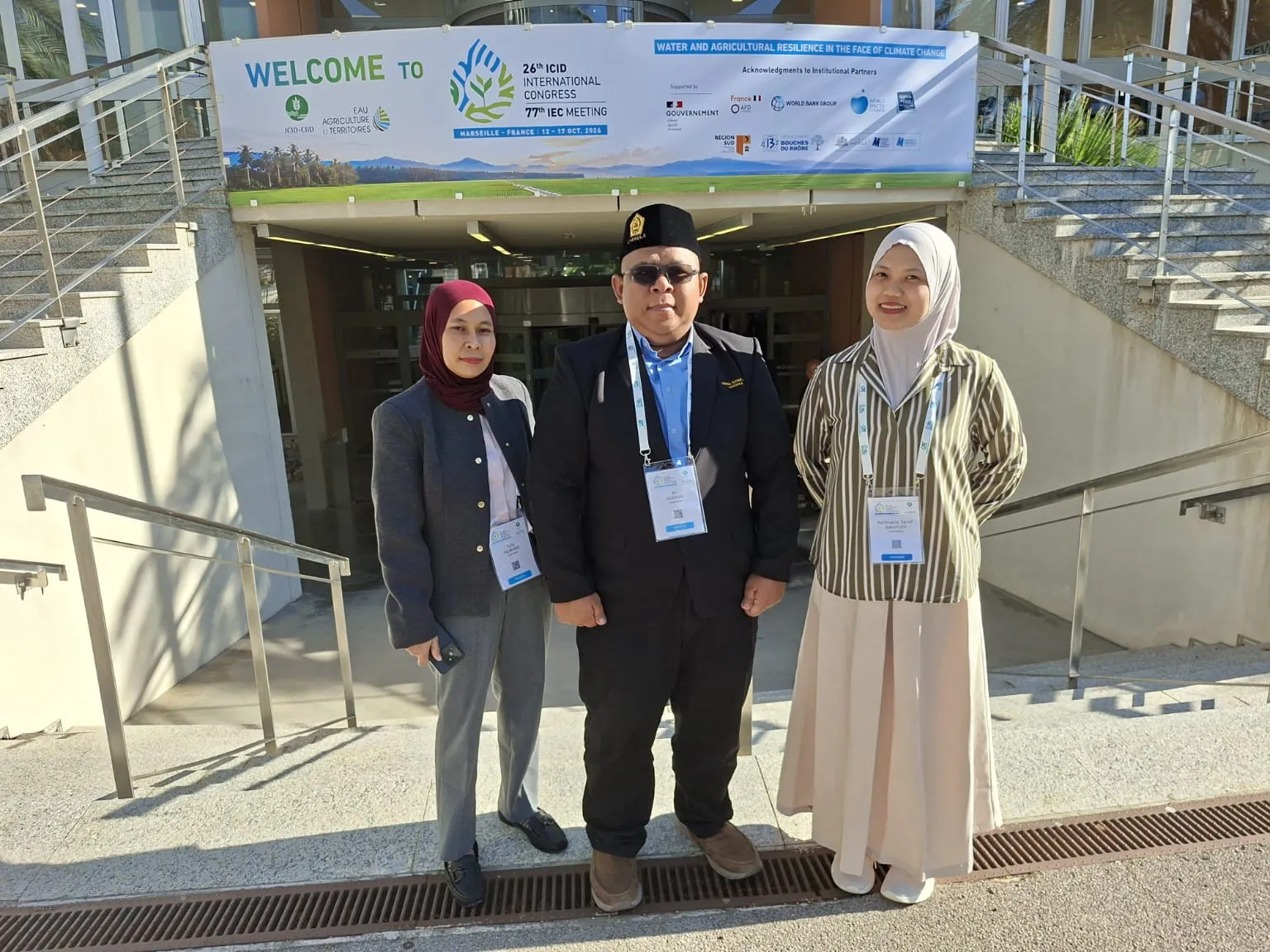
The expertise of Indonesian academics has once again gained international recognition. A delegation from the Civil Engineering Doctoral Program (PDTS) at Sultan Agung Islamic University (Unissula) successfully captured global attention at the 26th International Congress on Irrigation and Drainage (ICID), held from October 12–17, 2026, at Parc Chanot in Marseille, France. Through a cutting-edge, artificial intelligence-based approach, Unissula presented concrete solutions to the climate and water management challenges currently facing the world.
Unissula’s distinguished delegation comprised two doctoral students, Ari Sentani and Yulia Indriani, alongside research assistant Rahmatia Sarah Wahyudi. Before an audience of over 700 participants from approximately 50 countries—including experts from the United States, China, the United Kingdom, Japan, and the European Union—the Unissula team presented two strategic studies focused on river basins in Indonesia.
Unissula showcased two flagship, future-oriented technological innovations that offer a significant leap forward in water infrastructure management. The first study, presented by Ari Sentani, introduced the RIVANA modeling framework through a case study of the Tuntang River Basin. By integrating physical river processes with machine learning, RIVANA serves as a high-precision analytical tool for predicting erosion, sediment transport, and siltation risks—factors that frequently trigger flooding—thereby facilitating rapid and accurate decision-making in river management.
Meanwhile, Yulia Indriani presented research on optimizing water storage management in the Heritage Solo Valley and the Karangnongko River Basin. Utilizing reinforcement learning algorithms, this intelligent model can simulate and determine the optimal timing for water storage and release, serving as an effective decision-support tool to balance agricultural irrigation supplies while minimizing downstream flood risks. This initiative aligns with the congress's overarching theme—"Water and Agricultural Resilience in the Face of Climate Change"—which highlights the urgent need for food and water security amidst the global climate crisis.
The participation of the Unissula delegation in Marseille not only underscores the quality of the university's research—demonstrating its relevance to global issues—but also reaffirms its commitment to expanding academic networks and fostering cross-border research collaborations. Through its active contribution to the prestigious ICID 2026 forum—attended by major international bodies such as the FAO and the World Water Council—Unissula has successfully demonstrated that research conducted by the nation's own scholars can make a tangible contribution to the future of global water management.