
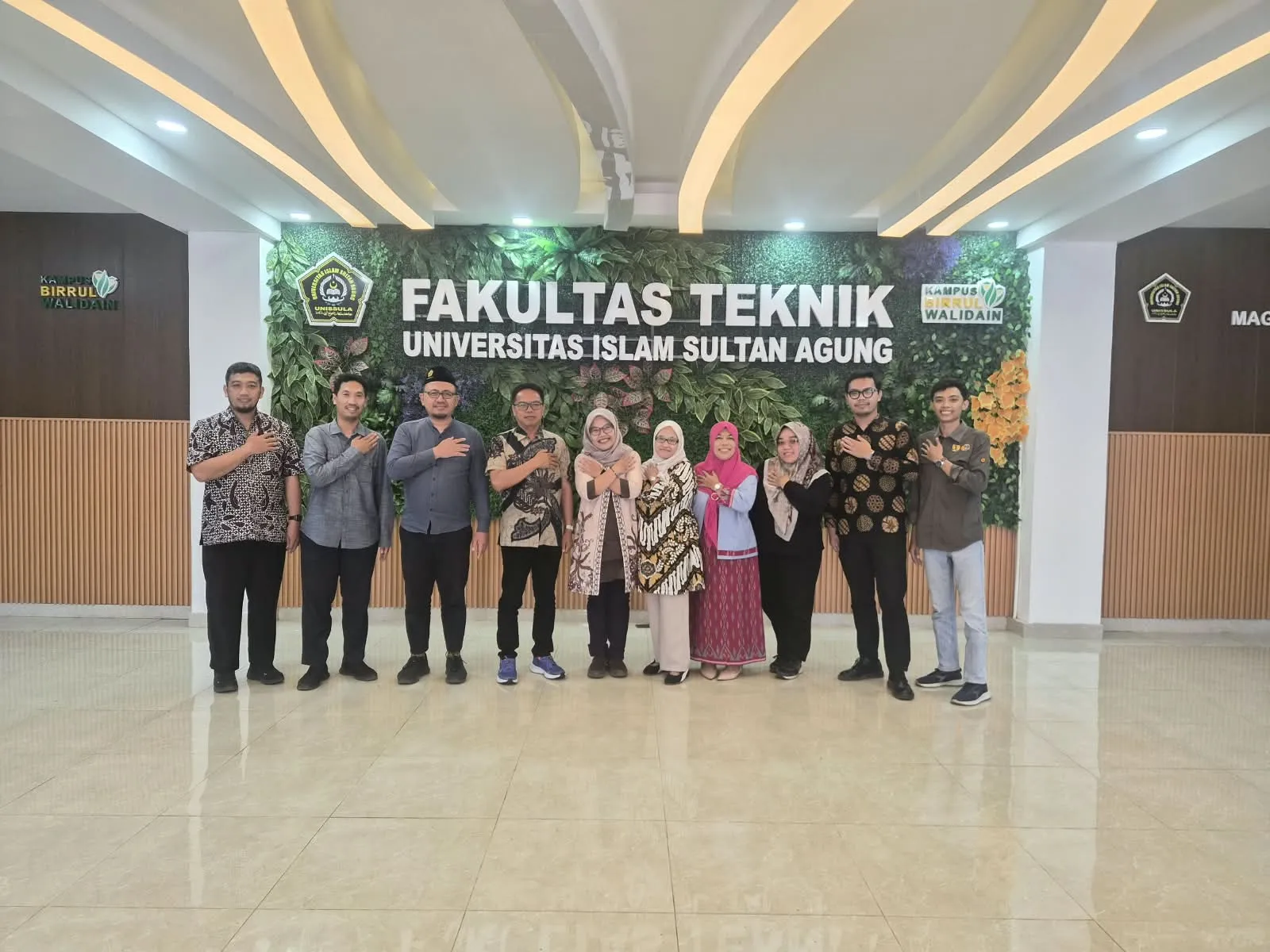
The Faculty of Engineering at Sultan Agung Islamic University (Unissula) hosted a visit from the Magetan Regency Public Works and Spatial Planning Agency (DPUPR) on Tuesday (October 6, 2026). This visit marked the initial step in coordinating a collaboration to formulate the Detailed Spatial Plan (RDTR) for Magetan Regency.
The meeting, held at the Unissula Faculty of Engineering, addressed the scope of work, characteristics of the planning area, data requirements, implementation stages, and the technical approach for formulating the RDTR.
This collaboration was initiated by the Regional and Urban Planning (PWK) Study Program at Unissula’s Faculty of Engineering, which possesses expertise in spatial planning, regional and urban development, spatial analysis, geographic information systems (GIS), infrastructure planning, and spatial utilization control.
During the initial coordination, both parties discussed the development conditions and dynamics of Magetan Regency as a foundation for the plan's formulation. Key aspects to be examined in depth include regional potential, spatial utilization issues, service structures, infrastructure, environmental and disaster-related conditions, and the direction of regional economic development.
Formulating the RDTR requires the integration of spatial data, existing regional conditions, development policies, environmental carrying capacity, and projections for area development. Consequently, the academic expertise of the Unissula PWK Study Program is expected to support a planning process that is data-driven and aligned with the region's specific characteristics.
This collaboration also strengthens the link between academic activities and practical planning in the field. Experience gained through planning studios, mapping, and spatial analysis is highly relevant to regional development needs, while also broadening the academic community's understanding of spatial planning issues and decision-making processes.
The RDTR plays a strategic role as an operational guideline for spatial utilization and control, infrastructure construction, and area development. The document also ensures certainty regarding spatial utilization for business activities and investment, in accordance with applicable regulations.
For the Unissula Faculty of Engineering, this collaboration represents an implementation of the "Tridharma" (Three Pillars of Higher Education) by applying scientific knowledge and academic expertise to support regional development. This partnership also reinforces the role of higher education institutions as strategic partners to the government in spatial planning.
Moving forward, coordination will proceed through data preparation and verification, field surveys, analysis of the planning area, and the formulation of development concepts, culminating in the drafting of detailed RDTR (Detailed Spatial Plan) content.
Through this collaboration, the drafting of the Magetan Regency RDTR is expected to yield a document that is actionable, grounded in the area's actual conditions, and capable of supporting effective and sustainable development control.