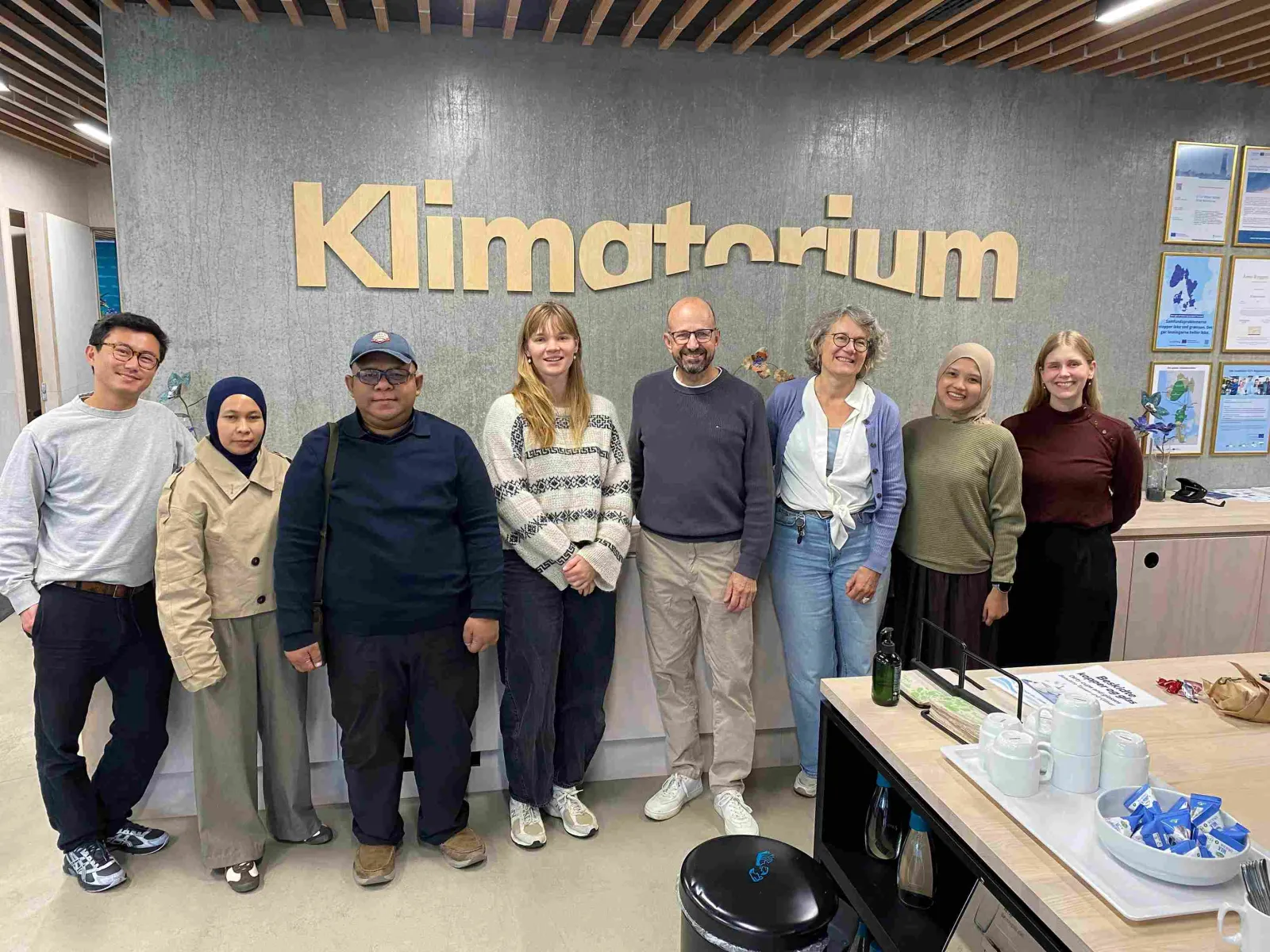
Students from the Doctoral Program in Civil Engineering (PDTS) at Unissula studied flood adaptation technology and water management in Denmark. The program took place from October 19–20, 2026, and included academic discussions and field visits. The group observed the implementation of infrastructure designed to address inundation, manage rainwater, and protect coastal areas.
The delegation consisted of Unissula PDTS students Ari Sentani and Yulia Indriani, along with research assistant Rahmatia Sarah Wahyudi. Sites visited included VIA University College in Horsens, the "Climate Road" (Klimavejen) in Hedensted, and several other locations in Lemvig. This experience provided insight into how civil engineering research is applied to address the challenges of climate change and water resource management.
At VIA University College, the group participated in academic discussions and explored research initiatives related to climate adaptation. Their study focused on areas such as surface water management, shallow groundwater, and localized rainwater handling. One example of applied research they examined was the "Climate Road" (Klimavejen).
The Climate Road was developed through a collaboration between VIA University College and the Municipality of Hedensted. This infrastructure integrates the functions of a roadway, a rainwater storage system, and a thermal energy harvesting unit. Rainwater enters through permeable asphalt and drainage channels, where it is temporarily stored to slow its flow into the broader drainage network.
The demonstration section of the Climate Road spans 50 meters in length and 8 meters in width, with a water storage capacity of up to 120 cubic meters. Additionally, heat-exchanger pipes embedded within the road structure are connected to a heat pump, which helps provide heating for a nearby kindergarten. Research published in the journal *Water* in 2022 recorded a thermal energy production of 98 megawatt-hours during the testing period from May 2019 to May 2021.
In addition to studying the design, the group also gained insight into the importance of infrastructure maintenance. The ability of pavement to absorb water can decline over time; periodic cleaning can help slow this degradation. This experience demonstrates that the success of sustainable infrastructure depends not only on the initial design but also on regular monitoring and maintenance.
The visit continued in Lemvig with a discussion involving the team from Klimatorium—a Danish international climate center that bridges the gap between research and the implementation of solutions within the community. Klimatorium fosters collaboration through a "quadruple helix" approach, which engages government, researchers, the business sector, and the public in the development and testing of various ideas.
Through its "Living Lab" facility, Klimatorium provides a real-world testing environment for technologies related to water management, climate adaptation, environmental protection, and resource reuse. This approach allows technology developers to interact with potential users and implementation partners from the testing phase onward, ensuring that the solutions developed can be evaluated based on actual needs and field conditions.
The group also visited a flood-adaptation "demo house" in Lemvig. Part of the RESIST project, the house is designed to withstand inundation up to a certain level. Its design concept allows some areas to take on water while keeping other zones protected from flooding; this approach helps reduce water pressure differentials that could otherwise compromise the building's structure.
In this demonstration house, the planned flood limit is set at 80 centimeters, in accordance with local conditions. Materials for the lower sections of the building were selected with water exposure in mind, while electrical installations are positioned at a higher elevation. The floors are designed with a specific slope, and drainage valves are installed to facilitate water removal once a flood recedes. Furthermore, the construction is designed for easy access to allow for drying, inspection, and repairs. Sensors are used to study how materials respond to inundation.
The next part of the study involved a visit to the Danish Coastal Authority (Kystdirektoratet). During this visit, the group discussed coastal protection, including the implementation of "sand nourishment" to address coastal erosion. This method involves adding sand to a beach or the shallow waters in front of it to replace sediment lost to erosion.
Adding sand helps maintain the beach's profile and width. The supply of sediment can also help dissipate wave energy before it reaches the areas behind the coastline. This process requires ongoing monitoring of shoreline changes and sediment movement, allowing the placement of sand to be tailored to the specific characteristics and needs of each location.
In addition to flood adaptation and coastal protection, the group studied wastewater treatment.