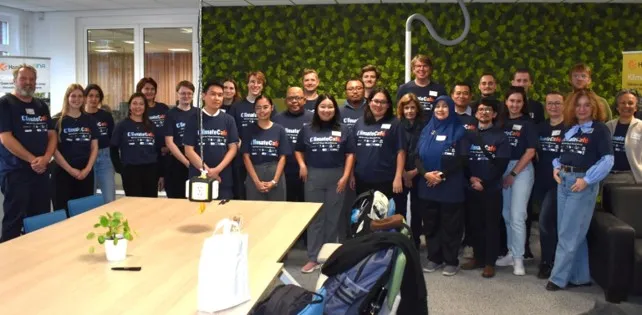
Faculty members from the Faculty of Engineering at Sultan Agung Islamic University (Unissula) introduced several innovations for climate change adaptation at the international ClimateCafé forum, held at Hanze University of Applied Sciences in Groningen, the Netherlands. The innovations presented included technologies for managing floods and droughts, floating houses, and nature-based solutions enhanced by artificial intelligence (AI). This participation took place during a visit by a Unissula delegation from October 26–30, 2026, with the ClimateCafé program serving as the primary agenda from October 28–30.
The Unissula delegation included the Head of the Doctoral Program in Civil Engineering, Prof. Dr. Ir. S. Imam Wahyudi, DEA; the Head of the Institute for Research and Community Service (LPPM), Prof. Dr. Ir. Henny Pratiwi Adi, ST, MT, IPU; the Vice Dean I of the Faculty of Engineering, Ir. Ari Sentani, ST, MSc, MPM; and Raden Mas Kusuma Dilaga from Unissula’s Office of International Affairs (OIA).
During the forum, the Unissula delegation highlighted the university's contributions toward helping communities address climate change. Their presentation integrated approaches involving infrastructure engineering, environmental conservation, and the application of technology. The session also opened a dialogue on the use of data and innovation to support decision-making in environmental management.
According to an official publication from Hanze University of Applied Sciences, this year’s ClimateCafé brought together approximately 75 participants from eight countries: the Netherlands, Denmark, Poland, the United Kingdom, Portugal, Latvia, Indonesia, and the Philippines. The participants—comprising researchers, students, professionals, and policymakers—shared knowledge and experiences regarding water-related challenges, droughts, and rising temperatures in urban areas.
The participation of the Unissula delegation served as an opportunity to showcase research outcomes and innovations from an Indonesian university to the international academic community. Through this forum, the faculty members from Unissula were able to exchange insights and experiences with scientists and practitioners from various countries. This meeting also opened up opportunities for networking and cross-border research collaboration.
One of the innovations presented was a modular tank system designed to address flooding and drought. This technology utilizes individual tank units that can be assembled as needed to retain and regulate water flow. According to the invention description published by the Directorate General of Intellectual Property, the structure is designed for easy assembly and disassembly. It can be used for purposes such as constructing emergency embankments or temporary dams to store water during periods of drought.
The delegation also introduced a "floating house" concept, featuring a concrete platform. This innovation offers an adaptive housing alternative for areas prone to inundation and fluctuating water levels, as the structure can adjust its position in response to changing water conditions. The development of this technology serves as an engineering approach to enhance residential resilience in flood-prone regions.
Another innovation presented involves the application of Nature-based Solutions (NbS), supported by artificial intelligence (AI) through the "Bahurekso Living Laboratory." This approach integrates climate change adaptation efforts with the utilization of ecosystem functions and data analysis technology. The goal is to develop solutions that account for both environmental conditions and the needs of the local community.
In practice, AI can assist in processing environmental data, identifying patterns of change, and comparing various management alternatives. The resulting analysis can inform the selection of nature-based interventions tailored to the specific characteristics of a given region. Through the Bahurekso Living Laboratory, this approach is developed as a space that bridges research activities with the practical implementation of solutions in the field.
The ClimateCafé agenda also provided participants with the opportunity to learn about the implementation of climate adaptation solutions firsthand. The program included not only presentations and workshops but also visits to climate adaptation testing facilities. On October 30, participants were scheduled to explore various examples of nature-based solutions and blue-green infrastructure in Groningen. This activity helps bridge the gap between academic discourse and environmental management practices in urban areas.
For the Unissula delegation, meeting participants from various countries serves as an opportunity to explore joint research. The exchange of experiences can bring together complementary expertise, while also creating openings to develop methods and test climate adaptation technologies. It is hoped that these networks will lead to sustained academic collaboration.
Participation in ClimateCafé is part of Unissula’s efforts to expand its international recognition as a "World Class Islamic University." The presence of faculty members from the Faculty of Engineering in this forum serves as a means to showcase their capabilities.
...Unissula’s research and innovation to the global academic community. Beyond expanding networks, this initiative also creates opportunities for the university to contribute to addressing the challenges of climate change.
For Unissula, an international reputation must be built through the quality of its education, research, and collaborations—efforts that deliver tangible benefits to society. The experience in Groningen serves as a step toward broadening collaboration and developing solutions for climate adaptation. In this way, the strengthening of global networks can go hand in hand with the scholarly responsibility to safeguard the environment and protect human life.